Friday, August 10, 2012

Yesterday (iOS)

I used to really enjoy point and click adventure games but I've kind of fallen off playing them in the past 10+ years. Part of that has been moving onto other genres and part of that has been Lucas Arts' retirement from the genre. That said, there have still been a number of studios that have consistently been making point and click games in the interim. One of those is Pendulo Studios who made the Runaway series of games and The Next Big Thing. I actually own the first Runaway game (Runaway: A Road Adventure) but as with many games I buy during Steam sales I've yet to even download it let alone play it! However, one I finish Pendulo's new game, Yesterday, I'll definitely be checking it out to see how it compares. 

Point and click adventures are perfect for the iOS - touch substitutes well for a mouse, there're slow paced, bite sized and you can save anywhere. Yesterday does some really neat things to make the user-experience even more streamlined. Since the last 'new' point and click adventure I played was (I think) Grim Fandango I don't know if these are additions developed specifically for this game or if they're now the genre standard.

The most notable feature is that when you double click on an area of the screen your character basically teleports to that new region rather than walking there. It may seem like a very simple, almost trivial, addition but it really helps speed up the gameplay when you don't have to wait for your player to complete his slow walking animation to get around the screen. This also helps to prevent the monotony of hunting around your environment at a snail's pace. 

Another great addition is a button that you press that automatically highlights all the objects in the environment that you can interact with! This completely removes all the frustration inherent to the 'pixel hunting' that was an integral part of old point and click adventures. 

Both of these additions are fantastic because they allow you to focus on the most important aspects of a click and point adventure - the puzzles and the story. There is nothing inherently skill based or enjoyable about clicking around the screen on every pixel to see if it's selectable (and then waiting for your character to walk around while doing it).

The story of Yesterday is difficult to explain without spoiling but it basically surrounds the main character, John Yesterday, a researcher on the occult who awakes in hospital after apparently attempting to commit suicide. What follows is a fairly serious story that weaves together the occult, satanism, murder, a grand conspiracy (of course) and also an element of fantasy. You can tell from some of the dialogue that this was a game perhaps not written by native English speakers or possibly translated from a different language (Pendulo Studios are based in Spain), but it doesn't ruin the narrative at all and there's still some very good characterization. 

The puzzles are also well done in that they're logical and actually make a modicum of sense. Sure the solutions to puzzles in the Monkey Island games were hilarious but some of them could only be solved with trial and error. I've yet to find a similarly annoying puzzle in Yesterday and as a result you actually get a sense of satisfaction when you do find a solution.  

Voice acting is solid except for one swarmi character who has the worst East Indian accent I've ever heard! Seriously, Pendulo - if you ever revive that character in a future game I'm available to do that character pro bono! The visuals are very good with some really nice art direction. This was actually a PC game first (see the pic above) so the graphics shrunk down to an iOS device look very crisp and clean. 

Yesterday is available for $6.99 on iTunes which, in the crazy economy of iOS games, seems like a lot but I've had a lot of fun with it so far and definitely think it's worth a look if you're interested in a new point and click adventure. 

Lavan

Wednesday, August 8, 2012

Remember arcade machines?

Sitting here in the departures lounge of Pearson Airport playing Yesterday (impressions coming soon) on my iPad while waiting for my flight to board I suddenly found myself nostalgic for old arcade machines. Growing up I never really went to stand-alone arcades until I was a teen so my exposure to arcade games initially came from visits to the airport as a child. Being part of an immigrant family growing up in the UK,  my dad would often find himself going to the airport regularly to either pick up or drop off numerous relatives and family friends. I'm guessing most 7 year old boys liked to go to the airport to see the airplanes. Not me. I saved up my change and went to the airport to play games whose graphics and sound would blow me away.


In the mid-80s any and all my gaming at home was done on my trusty Sinclair ZX-Spectrum 48K - games on tape, monochrome graphics and tinny sound. So when I went to the arcades (er...I mean the airport) and got to play things like Gauntlet, Space Harrier, and Outrun I was completely blown away. Arcade machines were this magical, mysterious powerhouses of gaming that utterly annihilated anything you could experience at home. Playing them also involved 45-60 minute drive to get there which added to the sense of occasion and wonderment.

Arcade-ports (remember them?) were a major selling point for home titles but could never come close to the majesty of their cabinet versions. I distinctly remember getting Paperboy for the Spectrum as a gift and being delighted that I was playing an arcade game at home!!

As I got older, I started to hang out more at the local community centre which also had a neat selection of different arcade machines that would rotate every few months. I remember playing the crap out of Double Dragon (another gem I ended up getting the Spectrum version for) and it was the first arcade game I ever finished. Around that time more and more intricate cabinets would be on show when I made a trip to the airport. I don't think I've ever been more floored by a video game than the first time I saw Hard Drivin' and it's colored 3D graphics and the Afterburner cockpit cabinet was like something from another planet! I was convinced if I did really well at it then Centauri would reveal that it was all a training exercise and I was ready to be a real life fighter pilot!

I was too young to experience Walter Day's golden age of gaming when Pac-Man, Defender and Missile Command created an insatiable buzz around arcades but I was around to experience the madness that was Street Fighter II's appearance on the arcade scene. It was incredible - people literally crowded around machines like something from a movie. The game itself was also stunning - amazing visuals with these gorgeous, colorful sprites and detailed backgrounds....and why is that guy in the Guile stage jerking off? Furthermore, in the pre-FAQ era it was also something of a mystery - how exactly did you pull off those flashy moves? Would someone tell you how to pull off a dragon punch? Isn't that supposed to be Mike Tyson? How are you supposed to pronounce Ryu? (for the record, I think I spent a decade incorrectly calling him 'Rye-You')

I wonder, though, if it was Street Fighter II (and specifically it's port to the SNES) that marked the beginning of the decline of arcades. I know arcade machines were still doing okay a decade later but I remember that SF II on the SNES was the first arcade-port where I thought to myself; "Wow, this almost is as good as the arcade version." It was the first inkling that you could have a system at home that could produce visuals that matched those magical cabinets at the arcade/community centre/airport/chippy. And that is, in my mind, why arcades are pretty much extinct - you can now have those types of experiences at home without having to pump in quarters. In fact, your phone probably supports a version of Street Fighter II that looks better than the original arcade machine!

I daren't say it's a shame that arcades have died (its innumerably more convenient to play games at home) but I do miss that sense of awe and wonder that came with those cabinets.

Lavan

Sunday, August 5, 2012

PES 2013 Demo Impressions

For as long as I can remember 'Seabass' Tekatsuka has been the top dog at Konami Computer Entertainment Tokyo and head producer of the Winning Eleven/Pro Evolution Soccer series. However, coinciding with the flagging fortunes of the WE/PES series (though I still maintain last year's title was somewhat of a return to form) there's been a shake-up at Konami and Seabass has been replaced by Kei Masuda. No word on whether or not he'll earn an aquatic nickname.

We got our first look at Masuda's work as the head of WE/PES when the demo for PES 2013 was released this week. It's available for the 360, PS3 and PC and features 4 International teams (Italy, Germany, England, and Portugal) and 4 South American club teams (Flamengo, Fluminense, Internacional and Santos). After extensive time with the 360 and PC versions I have to say I'm incredibly impressed with the improvements made to the game engine thus far.

I think the two biggest changes right off the bat are the passing/shooting system and the ball physics, particularly when it comes to dribbling and ball control. You can now turn off all the assists for passing and shooting and have almost full control over where the ball goes. Holding down L2/LT brings up an arrow that shows the direction that your pass or shot will go in. Also you can use R2/RT button to add curl/finesse to passes as well as shots. These two things allow you much more freedom with your passing and shooting. 

Ball physics, via the representation of ball control and momentum, are fantastic in the demo. There are new features where the changes are obvious such as holding down R2/RT when controlling a ball which brings it to a stop and close to you, or you press in the Right Stick when the ball approaches to flick it on. But the changes in physics are apparent with more granularity even with simple things like controlling a ball on the run - if you're turning or at a full sprint the ball won't be kept as close, if you slow down then it will. Of course, this also differs by players - Ozil can keep the ball close to him at all times versus a lumberjack like Andy Carroll who needs more time and space. 

The net result of this is the most fun dribbling model I've seen in a football game - even better than that found in FIFA 12. Even without using the R2 and Right Stick modifiers, just twisting and turning in tight spaces is a lot more fun and organic. When you throw in the aforementioned modifiers with the right players and you can pull off some magical moves. 

Fancy footwork has been present in both FIFA and WE/PES for the last few years but it hasn't been without problems. In FIFA 12 the problem was response time - in the Arena/Free mode you could pull off all the moves you want with ease, but when you try to do them against the CPU, the half-second lag between inputting commands and seeing the results was enough for you to lose the ball. In PES 2012, the issue was complexity - trying to pull off some of the moves was harder than a 10-hit Street Fighter combo!

In the PES 2013 demo, both issues seem addressed; there's minimal input lag between the controller and your player, and the moves themselves are much easier to do. I was actually able to 'Nutmeg' a defender (and mean it) without breaking my fingers! This makes using the skill players so much fun.

There are a few other improvements in the demo I thought were worthy of note:

- Give and go's are also altered as now you can select which general direction you'd like the initial passer to run in after he's dished off the ball. 

- The game still has the off-the-ball controls that last year's game had (where you can control a second player while you have the ball by flicking the right stick and then clicking the stick to initiate a run) but now adds a short corner feature where if you hold down the R1/RB button it brings a forward close for a short pass. 

- Lobs are finally back to the WE9-style and you can actually lob a keeper as you would do in real life (with the ball looping high with backspin). 

- The defending system is largely the same as PES 2012 (which was already quite good), but now double tapping the X/A button performs a lunging tackle (a happy medium between a standing and a sliding tackle)


As for negatives, one that has to be mentioned is the shoddy frame-rate in the 360 demo - it's pretty glaring at times and Konami really have to iron that out for the final release (it's not an issue in the PC version). Also, I didn't see too much variation in how the AI build up their attacks - everything seemed pretty direct and right up the field when the CPU got the ball. Finally, while you're given the option for full passing control almost everywhere on the field, the one area where it's absent is the crossing which is still, as far as I can tell, semi-auto.


I'm really enjoying the PES 2013 demo. On the PC, with the 'demo-extender' patch I've logged more than a few hours with various settings and it's been a ton of fun. I'm a soccer-whore so I was always going to buy both FIFA and PES this year but I'm definitely looking more forward to Konami's game.

Lavan

PS I threw together a quick montage video of action from the demo using Neymar. Hope you enjoy it.


Monday, July 30, 2012

Ace Combat: Assault Horizon


Remember Falcon 3.0, the harcore PC flight sim by Spectrum HoloByte? That game had a 250+ page manual and took a good hour to figure out how to take off without stalling and crashing several million dollars worth of virtual military technology. Namco's Ace Combat: Assault Horizon (AC:AH) is the polar opposite of that game. It's the 'Top Gun' of flight games - loud, dumb, and a ton of fun!!

AC:AH takes pretty much all of the complexity out of flying and focuses on providing as cinematic and action-packed experience as possible. The in-flight controls for planes are very basic - throttle with the triggers, the left stick is to pitch and roll, the bumbers control yaw. The physics are ludicrously loose - you can pull off any kind of harebrained maneuver without worry of blacking out and it takes an act of God to stall your plane. You also can't do a barrel roll for some reason.

Once you engage enemy fighters, you can use cannons and heat-seaking missiles to take down bogeys but the most fun comes when you get in close behind another plane and engage DFM ('Dog Fight Mode'.....yeah, I know...). You have to follow an enemy close for a few seconds before you can engage DFM but once you do (by pressing both bumpers together), the game basically takes control of 90% of the flying for you, zooms the camera close in and you're controlling a reticule to try and target your bogey. The combination of the visuals, sound design and controls makes this an incredibly thrilling experience. Because the computer is doing most of the flying for you (you're basically moving left or right to generally keep up with the fleeing target) it can create situations where you're occasionally flying between city buildings trying to shoot down another plane. When you do fire off the kill shot the camera dynamically follows the rocket in, shows your victim going up in flames and then cuts back. This never got old for me. The end of game stats showed I had shot down a couple of hundred planes by the end and I never once got bored of this mechanic.

The CPU pilots can also target you and if they close in behind you there's a neat feature where, while trying to evade/shake your tail, you can line up two markers and then perform 'a counter' whereby you flip your plane and instantly loop around behind your pursuer. It sounds dumb but it's incredibly cool to see/do and adds another demension to the dogflighting.

There's a similar mechanic for ground targeting that's just as fun called ASM (...ahem....'Air Strike Mode'....) where you have to line up with a designated entry point for a bombing run and once again the computer takes control of a large portion of the flying controls (you still can bank left or right) and you focus on raining hell on ground troops. 

Unlike previous Ace Combat games you also get to control helicopters. These missions are mostly support missions for ground troops in populated areas and have their own neat mechanics. You often have to use buildings for cover and with simplified controls it's easy to duck and weave between buildings. If someone fires a missile/rocket at you - no problem, just do a barrel roll to evade it....in a chopper (try not think about it too much).

Amazingly, for a Japanese game at least, AC:AH has a story penned by an actual 'writer' (we'll use that term lightly) - Jim DeFelice who's written a number of military thrillers. Unfortunately, though not unexpectedly, the the story is pretty rote and predictable but still a lot more involved than I thought it would be. The game takes place in 2015 where you play as Lt. Colonel William Bishop of the 108th Task Force (a multinational UN task force composed of NATO and Russian troops). You're leader of Warwolf Squadron and by the end of the game you have some semblance of attachment to the pilots in your squadron - contrast this to Ghost Recon: Future Soldier where you spend 10 hours with 3 other soldiers and I couldn't tell you their names to save my life.

The 108th Task Force is charged with stopping a Russian insurgent group, SRN, who are funded by the Russian mafia. This is all just an excuse for you to go flying missions around the world from East Africa, to Dubai, to Miami and a number of other locations. There are twists and turns in the story but you can see most of them coming a mile away. You also have a nemesis - Colonel Andrei Markov (you have to read that in a thick Russian accent) - who is the world's best fighter pilot or something. No prizes for guessing whom you fight near the end of the game. It's dumb, but it's dumb fun and I quite enjoyed the campyness of it all.

Graphically, this game is very, very pretty. There are a ton of different planes you can fly (and fly against) and there all modelled beautifully. Explosions are gorgeous as are the particle and smoke effects. Ground details, particularly around the cities are fantastic. Miami and Dubai are two particularly well presented cities with buildings galore to fly in and around.

Sound design is similarly impressive with immersive comms chatter and some very good use of surround sound with missiles and explosions all around. There is also a very rousing and grandiose orchestral score. The voice acting sits on the wrong side of the 'bad' vs. 'so bad it's good' line which is a shame because truly awful voice acting combined with the campy story would have made the narrative experience that much more fun. 

Regardless of the apathetic voice acting, AC:AH is a bucket-load of over-the-top fun. An average mission generally starts with an overly dramatic cut-scene furthering the silly story, then you're suddenly in the air and have to shoot down 20-30 planes in a single mission - don't worry, your plane can somehow carry 50-60 missiles! Throughout the dog-fighting you're routinely pulling 10G turns with the greatest of ease. Then at some point you're up against the opposition squadron's top dogfighter and on occasion you have to chase down an ICBM and shoot it out of mid-air. It' crazy, it's stupid and it's fun.

The game takes about 5-6 hours to finish which I felt was the perfect amount of time - any longer and I could see myself getting a bit bored but those 5-6 hours were an absolute blast. Best of all, the game can easily be bought new for $20-30 which is very reasonable and solid value for money.

If you're looking for anything approaching a flight sim I'd stay well clear, but if you're open to playing the the Air Force version of a Michael Bay summer blockbuster I think you'll have a blast.

Lavan

Thursday, July 26, 2012

Syndicate (360)

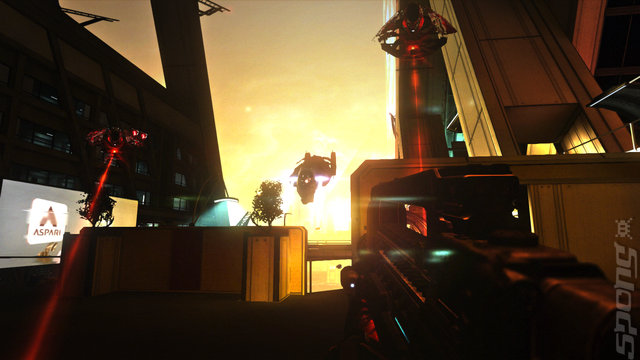
My love of last year's Deus Ex: Human Revolution has got me back into digging the cyberpunk genre in a big way. I was impressed by Syndicate's Skrillex heavy announcement trailer last year and recently got my hands on the game.

First off, while the original Syndicate was a 3/4 view isometric real-time 'strategy' game, this reboot is a First Person Shooter. This would have prompted yawns except it was developed by Starbreeze who made the excellent Darkness and Chronicles of Riddick games. Both of those games excelled in creating an engrossing atmosphere and engaging game world. They also both had a component of open-world/free-form gameplay to them as well.


Syndicate starts in 2069 where the world is no longer controlled by governments but by large corporations known as 'Syndicates'. Their control is made possible by the DART chip - an implanted brain chip that allows users to access the internet and renders most other electronic devices obsolete. In classic cyberpunk style the world is divided into those who have the chip (living in wealth and prosperity) and those who do not (who live in the ghettos). The powerful Syndicates employ bio-engineered/augmented security officers called 'Agents' for both protection and to engage in corporate espionage.

You control an agent named Miles Kilo (awful name, I know) who works for the world's largest Syndicate, Eurocorp, and has had the newest prototype DART chip implanted into his brain. 

This DART chip allows for several gameplay abilities that somewhat differentiate the game from the FPS norms. Tapping the Right Bumper (RB) brings up the 'DART Overlay' which adds a Matrix-style overlay to the visuals, highlighting enemies, important objects in the environment and also slows time slightly. You have three different 'Breach' abilities that are activated by targeting an enemy and then holding down the Left Bumper (LB). The Breach abilities allow you to hack into an enemy's DART chip force them to either commit suicide ('Suicide'), turn upon their allies ('Persuade'), or force their gun to explode ('Backfire'). 

Both the DART Overlay and the Breach abilities use an energy bar that is only refilled by either hacking objects in the environment or by killing enemies. Furthermore, the Breach abilities only work on those enemies that have implanted chips - so when you encounter those members of society who do not have them (and it's not much of a spoiler to mention that you do) you can't use them.

The shooting and controls in Syndicate are solid and the special abilities add flavour to all the encounters. Some later groups of enemies will have soldiers who have jammers that stop you from using Breach abilities (so you have to take them out first). There are also a good number of enemy types from heavies, to those with shields, mini-mechs and, of course, other Agents. The other Agents are your boss battles and while I'm generally not a fan of boss encounters in first person shooters, I think they work pretty well here because they force you to use your abilities and/or the environment in different ways.

You also gain experience points from each kill/hack/encounter and can then use these to upgrade your abilities in a fairly intricate upgrade tree which adds an RPG-lite component to the gameplay. 

Graphically, Syndicate is solid. I like the art style and look of the world but I still think Deus Ex: HR wins out in terms of art design and also the intricacy and level of detail found in the stages. You travel around future New York, Los Angeles and a floating city in the Atlantic. While the futuristic architecture is very well thought out and logical, there is nothing as stunning as Lower and Upper Hengsha that you find in Deus Ex. 

The faces and animations are excellent but there is some slow-down in the 360 version when there's too much going on at once - it only happens a handful of times but it's enough to mention. The DART-overlay and menu graphics are really well stylized but I felt at times the font sizes were too small and when I was trying to read emails/journal entries I had to strain.

The narrative itself is decent with requisite twists, turns and a very nice reveal towards the end of the story but it doesn't feel as fleshed out as it could be. The narrative leaves things open for a sequel but still manages to feel complete.  Starbreeze decided to use real-life actors for the other main characters who are both voice and facial captured. Brian Cox plays the head of Eurocorp and he is, as always, absolutely awesome as a maniacal megalomaniac. He was previously in Manhunt and Killzone and was brilliant in those two as well. The only other notable actor would be Rosario Dawson who plays Eurocorp's head scientist. While she is undoubtedly gorgeous I don't think she adds much to her character and I think EA/Starbreeze could have saved some money by going with a lesser-known actress.    

Syndicate features a very rich background fiction which is told through diary/journal entries and news articles you pick up. Unfortunately, none of this is really essential to the central narrative which is a shame and feels like a missed opportunity. It's fascinating reading about the other corporations, industrial espionage and also a rising revolutionary movement among deposed non-chipped individuals. The latter is somewhat touched upon in the narrative but not in as much detail as it deserves. 

After you're done the 10 hour single player story, the excellent co-op mode provides further enjoyment. In co-op you play as a team of 4 human-controlled Agents who have to take on various missions against the AI. Like all good multiplayer games (i.e. Battlefield 3) Syndicate rewards players that work together and each co-op player can play a variety of different roles from the bog-standard 'healer' to someone who specializes in hacking. The missions themselves are also quite varied from simple assassinations to stealing something from a rival Syndicate's compound and making it back out alive. 

Best of all, this is one EA game that doesn't require an online pass so if you do buy the game used/preowned/whatever you can still play this mode. 


I quite enjoyed Syndicate. It didn't blow me away but I had a lot of fun playing through the single player and co-op was engaging enough for me to forgo Battlefield 3 for a while. I think the game-world could have been fleshed out a bit more and I wish there was a bit more open-ness to the game (like in the Darkness) as it's fairly linear. Right now you can get Syndicate new for $30 and used for even cheaper. At either price, I think it's a good deal.

Lavan   

Friday, July 20, 2012

Ghost Recon: Future Soldier - Single Player Impressions


Ubisoft's Ghost Recon series has been around since 2001 with the original on the PC. I was first introduced to the series when it shifted from first person to third person view with 2006's Ghost Recon: Advanced Warfighter on the 360. I last played that game around 5 years ago and have two enduring memories of it; it looked absolutely gorgeous and that I enjoyed the slow, methodical, tactical pacing of the action.

Ghost Recon: Future Soldier (GRFS) is the newest game in the series but I think Ubisoft, seeing the success of more arcadey shooters like Call of Duty, have decided to try to balance the tactical nature of earlier games in the Ghost Recon series with more run-and-gun style seen in arcadey shooters. Unfortunately, the result is a game that seems caught in limbo between the two doctrines.

GRFS has all the features you'd expect in a top tier 3rd person shooter - cover mechanics, tons of different weapons, a Gears of War-style recovery/bleed-out and more. The 'Future Soldier' aspect comes from the variety of different gadgets and technology your 4-man team has access to. You can use a robotic drone to fly/drive around the battlefield to scope out and mark targets. You can also use Predator-style active camouflage to sneak around undetected. You also have a 'futuristic' HUD that shows the location of enemies through cover.

The controls are solid, very responsive and mention must be made of the ingenious way you can move from cover to cover. Once you're behind cover, you can look to another area of cover, hold down A and then you automatically run to that area. It's a very simple system but it works brilliantly and is something that other 3rd person games need to borrow.

So far, so good but unfortunately, the single-player experience falls flat because of gameplay that is in limbo between being a tactical shooter like the older Ghost Recon games and a more arcadey shooter like Gears of War. It also doesn't help that the mission design is often atrocious and that your teammate's AI is utter garbage. It seems as though more than a third of the missions are stealth-only missions that result in a game-over message the moment you're detected. A lot of times I found trial and error was the only way to get through them. Other missions are the complete opposite with infantry coming from every angle and you're running around the battlefield like Captain Price and Soap, absorbing bullets and capping Russians left, right and center a la Call of Duty (only COD does it better). The last 10 minutes of the game have you literally running through the forest chasing someone while shooting enemy troops along the way. Absolutely no tactical thought needed.

You can't order your teammates to move to different positions (you could in previous games) but you can mark/designate opposing soldiers for them to take out. Unfortunately, AI path-finding is awful. Through the course of the overly-long 10+ hour single-player campaign I had FIVE different instances where I had to re-start from a checkpoint because one of my AI squad-mates got stuck trying to walk through a wall rather than go through a door. I would be at the next check-point, waiting for it to unlock only to see a message stating I had to wait for all of my squad. I'd run back and then see one of the 3 generic idiots you roll with literally banging his head into a wall. For a 'triple A' title in 2012 that's just unacceptable.

The game's narrative is also disappointing because while you can clearly see a ton of effort was put into it (it's more than 10 hours long and there are a lot of cut-scenes as well as in-mission dialogue) it just doesn't come together. There's something about a Russian coup and missing weapons but I couldn't follow and really didn't give a shit after the first 2 hours. At some point in the middle you're in Siberia controlling an indestructible mini-mech with infinite rockets and you wonder why the Ghosts just don't take this thing with them wherever they go...

Ubisoft also tried to ape Battlefield: Bad Company's foursome of characters but while I can easily ring off the names of Sweetwater, Marlowe, Haggard and Redford I couldn't begin to tell you the names of the guys in GRFS. I know there's a guy with a southern accent and the black guy is your squad leader (even though you spend the entirety of the game giving HIM orders). That's about it.

It's all a shame because there are some good ideas here and there are a few, albeit brief, moments where everything comes together nicely such as a part of the level in Zambia where a Sandstorm comes in and reduces visibility to zero. Or, my favourite part of the game, the first section of the final mission where you have to assassinate several targets. Unfortunately, these moments don't make up for the mediocrity you have to endure the other 90% of the time.

The single-player in Ghost Recon: Future Soldier isn't bad (except for those times when the AI renders the game broken) but it's not very good either. If you're a huge fan of tactical shooters like the previous Ghost Recon: Advance Warfighter games I'd steer well clear - it's nothing like the other games. If you're a fan of run-and-gun 3rd person shooters I'd probably wait for this one to go on sale.

Lavan

Monday, July 9, 2012

Homefront (360)

I had meant to check out Homefront when it first came out but I was so busy that it passed me by. The game’s mixed reception and purportedly short campaign length didn’t light much of a fire under my ass to buy it. I eventually did buy a used (er...I mean ‘pre-owned’) copy at my local independent videogame store for $7.50 few weeks ago.  After finishing the single player campaign ofthis first-person shooter I have to say I quite enjoyed it but I’m also glad I didn’t pay full price ($60) for it.

For those who aren’t familiar with the story, Homefront starts with a story montage that begins in 2010 with some real-life footage of Hilary Clinton speaking after the sinking of the ROKS Cheonan.The montage continues with the death of Kim Jong Ill in 2012, whose son then reunites North and South Korea to form the Greater Korean Republic (GKR). Over the next 10 years the GKR gains massive power, a bird flu epidemic and theglobal economic crisis cripple the United States, and in 2024 the GKR detonates an EMP over the US rendering electronics and much of the nation`s infrastructure in ruins. In the resulting chaos the GKR invade and occupy the United States.

Yes, it`s Red Dawn, the videogame. Except they’re Koreans, not Russians.

The game begins two years after Korean occupation of the US and you play as a former Marine helicopter pilot namedJacobs. Sleeping in your makeshift Colorado apartment you’re suddenly awoken by GKR troops and dragged onto a bus going to a ‘re-education camp’.  Fortunately, your bus is ambushed by American resistance fighters who rescue you for the sole purpose of helping them in their plan to recover jet fuel for scattered U.S. military forces.

I’m a big fan of atmosphere and sense of place in games and Homefront really excels in these areas.  I really liked the suburban sections in Modern Warfare 2 where you fought off Russian invasion - the idea of modern military warfare taking place in the North American suburbs (a place most of us are familiar with in our day to day lives) is something I find incredibly intriguing. So, to see this concept more fleshed out in Homefront is a big thrill.

The first half of the game takes place in dilapidated and destroyed suburban Colorado (2 years into Korean occupation) and the attention to detail is amazing. At one point you’re running through back yards and along with the expected household destruction you also see remnants of a crashed Boeing 747 scattered around the place. In one area you come across a garage that has a 747 engine smashed into the side of it, around the cornerhalf of the fuselage lies down an alleyway.

My favourite area in the game is when you come across ‘Oasis’ a tiny, hidden resistance outpost with civilians intermixed with resistance fighters. The attention to detail in this section is incredible. You see rows of potted plants and vegetables laid out in logical fashion, hydroponics and water filtration systems, a little classroom with a blackboard and tiny children’s chairs, car batteries and solar panels arrayed to collect power, even sections of camouflage tarp strewn over open areas to hide the outpostfrom detection by airborne GKR forces! It really feels like a place where desperate people are trying to carve out some semblance of a normal life amidst chaos.

Tonally, the game starts out with a metaphorical punch to the gut. As you’re driven by GKR forces in a converted school bus to a ‘re-education’ camp, you’re able to look out the windows and can see GKR troops rounding up American citizens like cattle. At one point a GKR soldier grabs a resisting civilian from behind, puts a plastic bag over his head and begins to suffocate him as you drive past! The most disturbing segment occurs as the bus rounds a corner you see (and hear) GKR soldiers lining up a man and a woman against a wall while their toddler looks on screaming. The mom tells the toddler not to worry and then the GKR soldiers gun her and her husband down. The resulting sequence of a wailing toddler running up to, and embracing, the bodies of his killed parents struck me in a way no game has been able to before.

Kaos Studios wants you to know that the Korean occupation of the United States is brutal and they definitely succeed in the opening few minutes of this game.

It’s a shame, then, that such excellent atmosphere and environments are held back by shoddy characterization and poor story telling. Your AI-controlled team of fellow resistance members is made up of 4 other characters; Boone (the African-American leader of the resistance cell), Connor (a former marine), Rianna (an African-American female...no really, that’s her name) and Hopper (an Asian-American engineer). Unfortunately, apart from one scene where Connor tells Hopper he should sit out a meeting with some other rebels because they ‘probably don’t like Asians’ there isn’t anything remotely interesting about them or their interactions. Half-way through one of the main characters dies and while we’re supposed to care I wasn’t really bothered.

Likewise, the plot is paper-thin and the only twist/surprise can be seen a mile away. The plot and some mechanics also do a disservice to the excellent atmosphere created by the game. At one point you come across mass graves of American civilians, it’s a chilling moment – ruined by Connor suddenly screaming ‘motherfuckers’, shooting at the patrolling guards and then prompting a 10 minute cover-based firefight that culminates in you having hide under dead bodies with the on screen button prompt of, and I kid you not;

“Press X to Hide in Mass Grave”

*sigh*

The ending of the game is also somewhat bewildering. Not because it leaves things open – this was clearly intended to be the first game in a series and the story of how the resistance to GKR occupation took it’s first steps towards reclaiming America – but because in the space of about 3 seconds a main character decides to sacrifice himself to save the mission. I don’t want to give away too many details but you spend the prior 30 minutes fighting improbable odds, then you get a quick cut away to somereinforcements – you’re thinking, alright, I guess we have to kill them too – but then your squad-mate decides he’ll just off himself to save the day.There’s zero build up to what should be a very dramatic moment -  he just sees the bad guys and then he’s off toget himself killed and I’m left there with the controller thinking;

i.                    Wait...what just happened? Did he just kill himself? Did the game just end?

And

ii.                  He really didn’t need to do that. At all. Particularly since we spent the rest of the game fighting similarly bleak odds.
                      
It would be like an alternate cut of Return of the Jedi where, when Lando Calrissian is flying deep in the bowels of the Death Star, lines up to shoot the reactor core and then at the last minute decides to fly the Millennium Falcon into it killing himself and poor Nien Nub – roll credits. What. The. Fuck?

Gameplay-wise I think Homefront got a bad rep from a lot of mainstream reviewers as it’s a perfectly serviceables hooter. The aiming and movement mechanics are generally tight and there’s a nice weapon selection. It’s completely linear and scripted but so are the single player experiences of most first person shooters. It doesn’t have the sharpness of the CoD engine and it doesn’t have the destruction found inB attlefield but it’s still fun to aim down the sights and take out bad guys.

The biggest shortcoming of the single-player is the length. I am not particularly great at shooters but I finished this game on the default (Normal) difficulty setting in three and a half hours! While I don’t expect shooters to have 20+ hours of gameplay, three and a bit hours is frankly ridiculous. I’m not particularly upset since I bought this game used for less than ten dollars but if I picked it up for full price I would have been pissed.

There is a very robust multiplayer component to the game but since I bought it used I’d have to pay $10 for an online pass to be able to play beyond the first 5 levels (of player progression). I hit level 5 in about 40 minutes and while it’s a fun experience with some neat ideas (you use points you get from killing enemies/achieving objectives to purchase in-match vehicles, weapons, etc) I would still rather play Battlefield 3 or even CoD.

Despite some pretty poor scores from high-profile gaming sites (Gamespot gave it a 4/10) Homefront still managed to sell around a million copies – largely in part to some very aggressive (and undoubtedly expensive) marketing. Unfortunately, expectations from publisher THQ were much higher and this resulted in the closure of the developer Kaos Studios.  It’s a shame because there are some very neat ideas here. Fortunately, Crytek Nottingham have been tasked with making a sequel which makes me quite excited. I really loved Crysis 2 and hope Crytek’s Nottingham studio is as talented as their Frankfurt one.

Lavan